🌟 Comets, Asteroids, and Meteors
"We are all made of star stuff. We are a way for the cosmos to know itself through the remnants of ancient worlds."
☄️ Wanderers of the Solar System
Our solar system is filled with fascinating celestial travelers that have captivated humanity for millennia. From the spectacular displays of comets with their glowing tails to the silent, rocky asteroids that preserve the building blocks of worlds, these objects tell the story of our solar system's formation and evolution.
⚠️ Recent Close Encounter
In June 2024, the 500-foot wide asteroid 2024 MK passed very close to Earth at just 184,000 miles - less than the distance to the Moon! NASA's radar tracked this cosmic visitor, reminding us that our planet exists in a dynamic, debris-filled solar system.
Today, we'll explore the differences between comets, asteroids, and meteors, understand their origins, and discover why NASA tracks thousands of these objects for planetary protection.
🎯 Learning Objectives
⭐ Course Competency CC3.1
Explain the origin and properties of the celestial bodies in our solar system
✅ LO3.1.2
Distinguish between comets, asteroids, and meteors in the solar system, including their composition, origin, and behavior.
🔍 Classification Skills
Identify key characteristics that differentiate these celestial bodies and understand their roles in solar system dynamics.
🛡️ Planetary Defense
Understand why NASA tracks near-Earth objects and the potential threats they pose to our planet.
📚 Required Readings
Primary Reading
- 📖 Physical Science, 13th Edition - Chapter 15, Section 15.3 by Bill Tillery
Supplementary Resources
📊 Interactive Activity 1: Journey of a Comet
Instructions: Arrange the following events in the correct order to show what happens when a comet approaches the Sun. Understanding this sequence helps explain why comets develop their spectacular tails.
Learning Note: Comet tails always point away from the Sun due to solar wind pressure, not because of the comet's motion. This is why comets can have tails when moving away from the Sun too!
📋 Interactive Activity 2: Celestial Body Classification
Instructions: Sort the following characteristics and examples into the correct categories. This will help you understand the fundamental differences between these three types of celestial objects.
Asteroids
Rocky or metallic objects, mostly in asteroid belt
Comets
"Dirty snowballs" from outer solar system
Meteors/Meteoroids
Small fragments that can enter Earth's atmosphere
Key Distinction: Location and composition are the main differences: asteroids are rocky and nearby, comets are icy and distant, meteors are tiny fragments from either that enter our atmosphere.
🔭 Understanding Our Celestial Neighbors
Asteroids Rocky Remnants
Composition: Primarily rock and metal, similar to terrestrial planets. These are leftover building blocks from the solar system's formation 4.6 billion years ago.
Location: Most asteroids reside in the Main Belt between Mars and Jupiter, though some have orbits that bring them near Earth.
Characteristics: Irregular shapes, no atmosphere, and they don't develop tails when approaching the Sun. Sizes range from small boulders to Ceres, which is 940 km in diameter.
Notable Examples
- Ceres: Largest asteroid, classified as a dwarf planet
- Vesta: One of the brightest asteroids visible from Earth
- Eros: First asteroid orbited by a spacecraft
Comets Dirty Snowballs
Composition: A mixture of ice, rock, dust, and organic compounds. Often called "dirty snowballs" due to their icy cores mixed with rocky material.
Origin: Most originate from the Kuiper Belt (short-period comets) or the Oort Cloud (long-period comets), far beyond Pluto's orbit.
Behavior: When approaching the Sun, solar radiation causes ices to sublimate, creating a glowing coma and spectacular tails that can stretch millions of kilometers.
Famous Comets
- Halley's Comet: Returns every 76 years, last seen 1986
- Hale-Bopp: Visible for 18 months in 1990s
- NEOWISE: Recent bright comet visible in 2020
Meteors & Meteoroids Sky Fire
Definition: Meteoroids are small fragments from asteroids or comets. When they enter Earth's atmosphere, they become meteors - the bright streaks we see in the sky.
Size Range: From microscopic dust particles to house-sized boulders. Most are smaller than a grain of sand but create spectacular light shows.
Fate: Most burn up completely in the atmosphere due to friction, but larger ones may survive as meteorites that reach the ground.
Meteor Terminology
- Meteoroid: Object in space
- Meteor: Light phenomenon in atmosphere
- Meteorite: Object that reaches ground
- Fireball: Very bright meteor
- Bolide: Exploding fireball
🛰️ NASA's Eyes on Asteroids
NASA tracks thousands of near-Earth objects for planetary defense. This interactive tool shows real asteroid positions and orbits. Use the controls to move through time and see how these objects move through our solar system.
🎮 How to Use the Interactive
Time Control: Grab the clock icon near the bottom and move it right to go forward in time, left to go backward. View Control: Click and drag the main screen to change your viewing angle.
NASA's Eyes on Asteroids - Interactive 3D visualization
For the full experience, visit NASA's Eyes on Asteroids directly.
📹 Visual Learning
Differences Between Asteroids, Comets, and Meteors
NASA explanation of the key differences | Duration: 1:25
📷 Recent Asteroid Encounter
View the actual radar images of asteroid 2024 MK captured by NASA's Goldstone Solar System Radar as it passed within 184,000 miles of Earth in June 2024.
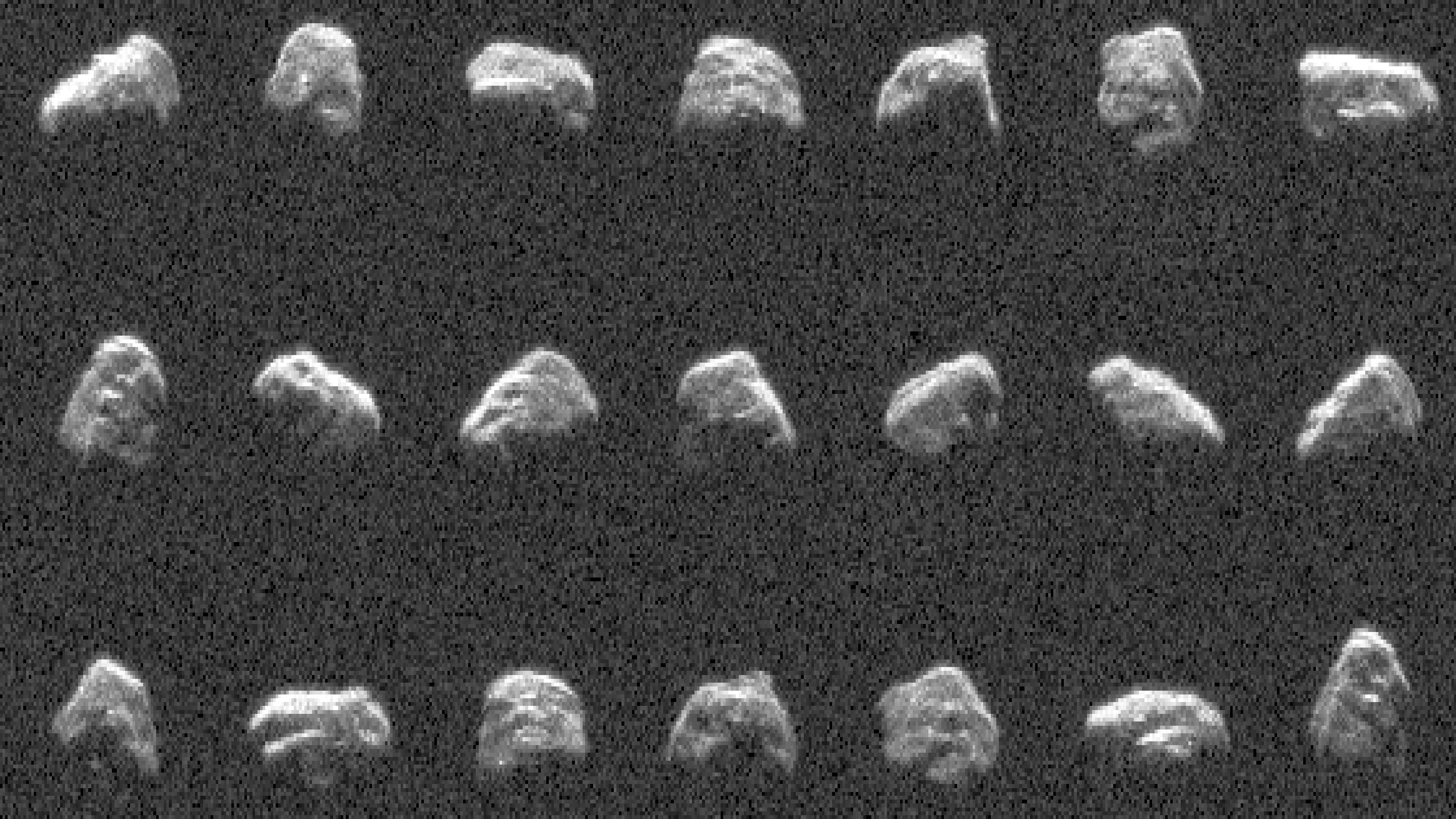
Credit: NASA/JPL-Caltech
📋 Practice and Apply
❓ Reflection Questions
Question 1: After exploring NASA's asteroid tracking tool, were you surprised by how many objects are in our solar system near Earth?
Consider these points...
Most students are amazed to learn that NASA tracks over 30,000 near-Earth objects. This highlights both the dynamic nature of our solar system and the importance of planetary defense programs.
Question 2: What is a comet and how does it differ from an asteroid?
Click to reveal answer
Comet: A ball of ice, rock, and dust that orbits the Sun, originating from the outer solar system.
Key Difference: Asteroids are primarily rocky and metallic, found mainly in the asteroid belt. Comets are icy and develop glowing tails when approaching the Sun due to ice sublimation.
Question 3: Explain the relationship between meteoroids, meteors, and meteorites.
Click to reveal answer
- Meteoroid: Small fragment in space (from asteroid or comet)
- Meteor: The bright streak when meteoroid enters atmosphere
- Meteorite: Any piece that survives atmospheric entry and reaches the ground
🧠 Critical Thinking Challenge
Why do you think NASA prioritizes tracking near-Earth objects? Consider the potential consequences and benefits of this monitoring program.
Explore the reasoning...
NASA's tracking serves multiple purposes: early warning for potential impacts, understanding of solar system evolution, identification of resources for future missions, and development of planetary defense strategies. The Chicxulub impact that caused dinosaur extinction shows why this monitoring is crucial for life on Earth.
PHYS-1315 Physical Science I | Module 3, Lesson 2
Enhanced with CidiLabs Interactive Activities
☄️ Next: Explore the origins of our entire solar system!