Module Item Completion (built in browser, hidden in app)
PHYS-1315M9L2 Climate Change
"Global warming is only one aspect of climate change where the lower atmosphere warms because of increased greenhouse gas concentrations. This small temperature increase of a few degrees Celsius can be enough to change the climate we are familiar with."
— Climate Science Introduction
Understanding Climate Change
Climate change represents one of the most significant scientific challenges of our time. While global warming - the increase in Earth's average surface temperature - is the most widely known aspect, climate change encompasses a broader range of atmospheric phenomena including stratospheric cooling, changing precipitation patterns, and more extreme weather events.
The science behind climate change involves complex interactions between greenhouse gases, radiation physics, and feedback loops in Earth's climate system. Understanding these mechanisms helps us distinguish between natural climate variations and anthropogenic (human-caused) changes occurring today.
Key Climate Indicators
Anthropogenic Evidence: The simultaneous warming of the troposphere and cooling of the stratosphere provides a distinctive "fingerprint" that proves current climate change is caused by increased greenhouse gases, not solar variation.
Learning Objectives
Course Competency CC9.1
Differentiate components of the Earth's weather and climate
LO9.1.1
Analyze the types cloud-forming processes and the origin of precipitation
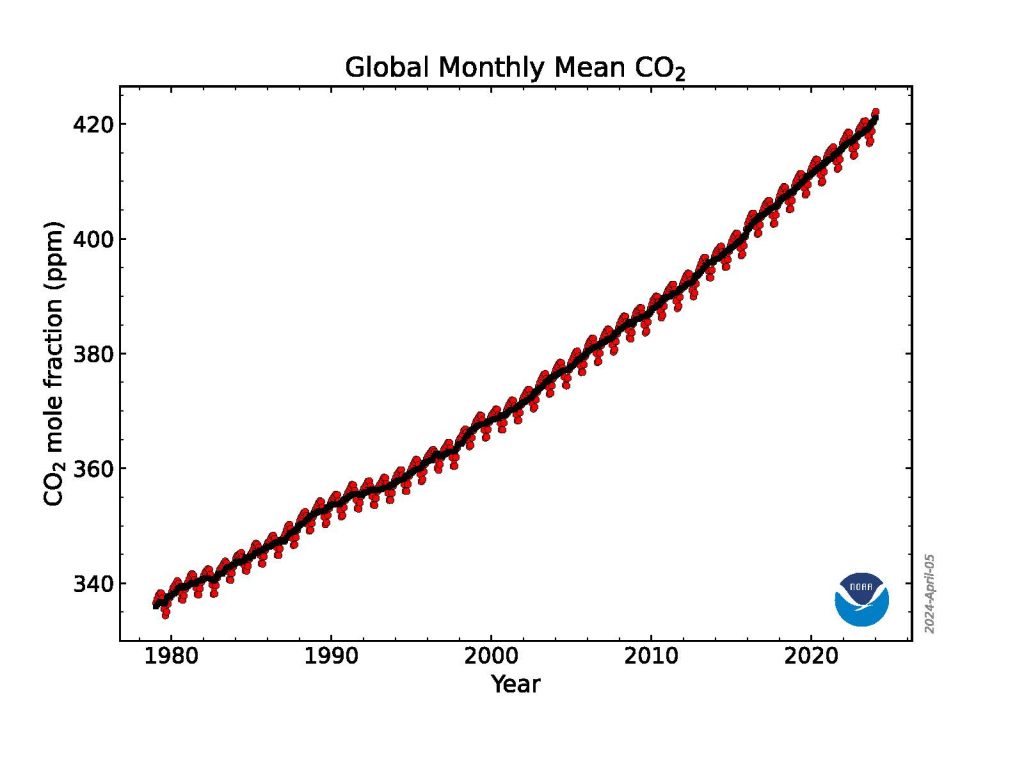
Atmospheric CO₂ concentration continues rising with no sign of slowing, reaching levels not seen since the Pliocene epoch when sea levels were 15-25 meters higher than today.
Instructions: Arrange the steps of the greenhouse effect in the correct order. Understanding this sequence explains how greenhouse gases affect Earth's energy balance and drive climate change.
Solar Energy Input
Sun emits visible and near-infrared radiation that reaches Earth's surface and atmosphere
Surface Absorption and Heating
Earth's surface absorbs solar energy and warms, increasing its temperature
Infrared Emission
Warmed Earth surface emits infrared (heat) radiation back toward space
Greenhouse Gas Absorption
Atmospheric CO₂, H₂O, and CH₄ absorb outgoing infrared radiation
Atmospheric Re-emission
Greenhouse gases re-emit infrared energy in all directions, including back toward surface
Temperature Increase
Additional trapped energy warms surface and lower atmosphere above natural levels
Greenhouse Physics: This process involves electromagnetic radiation, molecular absorption spectra, and energy conservation. Greenhouse gases are transparent to visible light but absorb specific infrared wavelengths. More greenhouse gas molecules mean more absorption and re-emission, enhancing the natural greenhouse effect that makes Earth habitable but causing warming when concentrations increase.
Instructions: Sort the following climate factors into their correct categories. Understanding these classifications helps distinguish between natural climate variations and anthropogenic influences.
Greenhouse Gases
Atmospheric gases affecting heat retention
Natural Climate Factors
Historical climate change drivers
Anthropogenic Causes
Human activities affecting climate
Climate Change Impacts
Observable effects and consequences
Carbon dioxide (CO₂)
Methane (CH₄)
Water vapor (H₂O)
Nitrous oxide (N₂O)
Solar activity variations
Volcanic eruptions
Ocean current changes
Milankovitch cycles (orbital)
Fossil fuel combustion
Deforestation
Industrial processes
Agriculture and livestock
Glacier and ice cap melting
Sea level rise
Stratospheric cooling
Extreme weather intensification
Climate System Analysis: Greenhouse gases trap heat through molecular absorption of infrared radiation. Natural factors have driven past climate changes over geological timescales. Current anthropogenic factors, primarily fossil fuel emissions, are causing rapid changes. Observable impacts provide evidence for ongoing climate system changes. The key distinction: natural factors would cause both atmospheric layers to warm, while greenhouse gases cause tropospheric warming and stratospheric cooling.
Interactive Activity 3: Climate Science Concepts
Instructions: Click each card to reveal detailed information about climate change mechanisms, evidence, and impacts. These concepts form the scientific foundation for understanding anthropogenic climate change.
Global Warming
Surface Temperature Rise
Tropospheric Warming
• Definition: Increase in Earth's average surface temperature
• Current trend: ~1.1°C above pre-industrial levels
• Rate: 0.18°C per decade since 1981
• Cause: Enhanced greenhouse effect
• Evidence: Temperature records, ice core data
• Small changes have large climate impacts
Stratospheric Cooling
Upper Atmosphere
Anthropogenic Fingerprint
• Rate: ~0.5°C cooling per decade since 1967
• Altitude: 12-50 km above surface
• Mechanism: CO₂ absorbs less solar energy at height
• Evidence: Satellite temperature measurements
• Significance: Proves greenhouse gas cause
• If solar, both layers would warm
Greenhouse Gases
Heat-Trapping Molecules
Infrared Absorption
• CO₂: 421+ ppm, main anthropogenic driver
• CH₄: 28× more potent than CO₂
• H₂O: Natural, increases with warming
• Mechanism: Absorb specific IR wavelengths
• Result: Energy trapped in atmosphere
• Natural effect essential for life
Positive Feedback
Self-Reinforcing
Amplifying Climate Change
• Ice-albedo: Dark ocean absorbs more than ice
• Permafrost: Melting releases CO₂ and CH₄
• Water vapor: Warmer air holds more moisture
• Forest fires: Release stored carbon
• Result: Accelerates initial warming
• Makes climate more sensitive to changes
Anthropogenic Evidence
Human Fingerprints
Multiple Lines of Evidence
• Isotopic analysis: CO₂ from fossil fuels
• Timing: Rapid change since 1950s
• Pattern: Warming at night/winter
• Altitude: Troposphere warms, stratosphere cools
• Geography: Arctic amplification
• Distinct from natural variability
Historical Context
Past Climate
Natural Climate Drivers
• Solar variations: 11-year and longer cycles
• Volcanic eruptions: Temporary cooling
• Ocean cycles: El Niño, Atlantic oscillations
• Orbital cycles: Ice age timing
• Rate: Much slower than current change
• Current rate unprecedented in human history
Climate Impacts
Observable Changes
Global Consequences
• Ice loss: Glaciers, ice sheets, sea ice
• Sea level: ~3.3 mm rise per year
• Weather: More extreme events
• Ecosystems: Species range shifts
• Ocean: Acidification, warming
• Affects human societies globally
First "Global Warming"
Scientific History
Term Origins
• Date: August 8, 1975
• Journal: Science magazine
• Title: "Are We on the Brink of Pronounced Global Warming?"
• Before: Called "inadvertent climate modification"
• Prediction: Accurate forecast of warming
• Science identified the issue early
Scientific Evidence for Climate Change
Rising CO₂ Concentrations
Globally averaged monthly mean carbon dioxide abundance measured at NOAA's global network of air sampling sites since 1980. The steady increase shows continuous CO₂ accumulation in the atmosphere. Credit: NOAA Global Monitoring Laboratory
Atmospheric Temperature Changes (1986-2022)
From 1986 to 2022, temperatures declined in the higher levels of Earth's atmosphere (starting at top left, blue shades) while increasing in the layers closest to Earth's surface (bottom row, red shades). This pattern provides definitive evidence that climate change is caused by greenhouse gases, not solar variations. Credit: Benjamin Santer, UCLA
Use this tool to explore current climate conditions and observe the data behind climate science.
Practice and Apply
PROMPT: What is stratospheric cooling?
Question: Define stratospheric cooling and explain its significance for climate science.
Click to reveal answer
Answer: This is the effect where the upper atmosphere has cooled by about 0.5°C per decade.
Scientific significance: Stratospheric cooling, combined with tropospheric warming, provides definitive evidence that climate change is caused by increased greenhouse gases rather than solar variations. If climate change were caused by increased solar energy, both atmospheric layers would warm. The opposite pattern (surface warming, upper cooling) is the unique signature of enhanced greenhouse effect.
PROMPT: Explain positive feedback loops in climate change.
Question: How do positive feedback loops accelerate climate change?
Click to reveal answer
Answer: Positive feedback loops amplify initial changes rather than counteracting them.
Examples:
Ice-albedo feedback: Melting white ice reveals dark ocean water, which absorbs more solar energy and causes more melting
Permafrost feedback: Warming melts permafrost, releasing trapped CO₂ and methane, causing more warming
Water vapor feedback: Warmer air holds more moisture, and water vapor is a greenhouse gas
These feedbacks make the climate system more sensitive to greenhouse gas increases.
PHYS-1315 Physical Science I | Module 9, Lesson 2
Enhanced with CidiLabs Interactive Activities
Course Complete - You've mastered the fundamentals of physical science!