Module Item Completion (built in browser, hidden in app)
PHYS-1315M9L2 Climate Change
In this lesson you learn some of the basic science behind climate change. One aspect of climate change is global warming where the lower atmosphere warms because of an increase concentration of greenhouse gases. This change in temperature is relatively small, only an increase of few degrees Celsius, but that can be enough to change the climate that we are normally familiar with. You'll also learn about stratospheric cooling where the upper atmosphere has cooled for the same reason, and this is how we know climate change is anthropogenic (meaning man made).
Course Competencies and Learning Objectives
A ★ indicates that this page contains content related to that LO.
CC9.1 Differentiate components of the Earth’s weather and climate
LO9.1.1 Analyze the types cloud-forming processes and the origin of precipitation
LO9.1.2 Describe the major storms formed on Earth
★ LO9.1.3 Describe climate change and its causes
Readings
Read Chapter 23, Section 3 ofPhysical Science, 13th edition by Bill Tillery McGraw Hill Education
Global Warming is only one aspect of climate change in which surface temperatures of the Earth have increased. The term was first used on 8/08/1975 in a paper Climatic Change: Are We on the Brink of a Pronounced Global Warming? published in the journal Science. Before then the term "inadvertent climate modification" was often used.
Other effects
As mentioned earlier, global warming is one aspect of climate change, and there are others such as: more extreme and frequent weather events, upper atmospheric cooling, drought, glaciers melt, ocean acidification, rising sea levels, and even longer days. This doesn't mean that climate change is the apocalypse, but because we have generally found our climate comfortable changing it can be unpleasant for us. The Earth's climate has significantly changed many times over the planet's history, and in the past the cause has primarily been due to changes in solar activity, volcanic eruptions, and changes in the composition of atmosphere due to plant life. The current change in climate seems to be driven by increasing atmospheric carbon dioxide from the burning of fossil fuels, and because it is man-made it is described as being anthropogenic.
Positive Feedback Loops
One of the biggest problems with the climate change that we are seeing are positive feedback loops. Negative feedback loops are often found in engineered systems to control something. For example, most homes have a climate control system where when the thermostat reads that the temperature of the dwelling that is higher than some threshold it turns the AC system on to cool it down, and once the temperature is low enough the AC system is turned off. In this example, the feedback is the output of the AC system and it has the effect of changing the temperature in the opposite direction (i.e. negative) that it had been going. In positive feedback systems the system will change so as to continue increasing that change. A positive feedback in the previous example would be if the temperature were too high the thermostat would turn on the heater to further increase the temperature and it never gets turned off.
In the case of climate change, global warming causes glaciers and the polar ice caps to melt and the permafrost to defrost. The polar ice caps and glaciers are white and reflect solar radiation, when these melt there is less reflected light and they become dark ocean water which absorbs light, warms, and further contributes to melting. The melting permafrost also releases trapped carbon dioxide and methane into the atmosphere which further drivers climate change.
Interactive
NASA has an online interactive that you can use to explore the Earth's climate change. Follow this link https://climate.nasa.gov/earth-now/ to explore it. Here's a how-to video that explains how to use the interactive:
Can This Happen Again? Storm of the Century
In this video, there is a focus on the 1993 mid-March winter storm in Alabama. March is usually a month where spring is solidly becoming entrenched as far as the season goes for a state this far south. Weather forecasters were even hesitant to bring the news to the weather forecast without giving it a very careful second look. It was quite a storm when it arrived. So, with there still being some intense winter weather in an era where most of the talk is about global warming, how do these storms fit in?
The atmosphere is primarily composed of nitrogen (78%), oxygen (21%), and most of the remaining 1% is argon. This atmosphere is responsible for keeping the planet at 16 °C instead of -18 °C without it. Those gases do not interact with infrared radiation. The gases that do interact strongly with infrared radiation are known as the greenhouse gases, and even though they makeup a fairly small fraction of the atmosphere their effect is significant. The primary greenhouse gases are: water vapor, carbon dioxide, and methane.
Increases in CO2
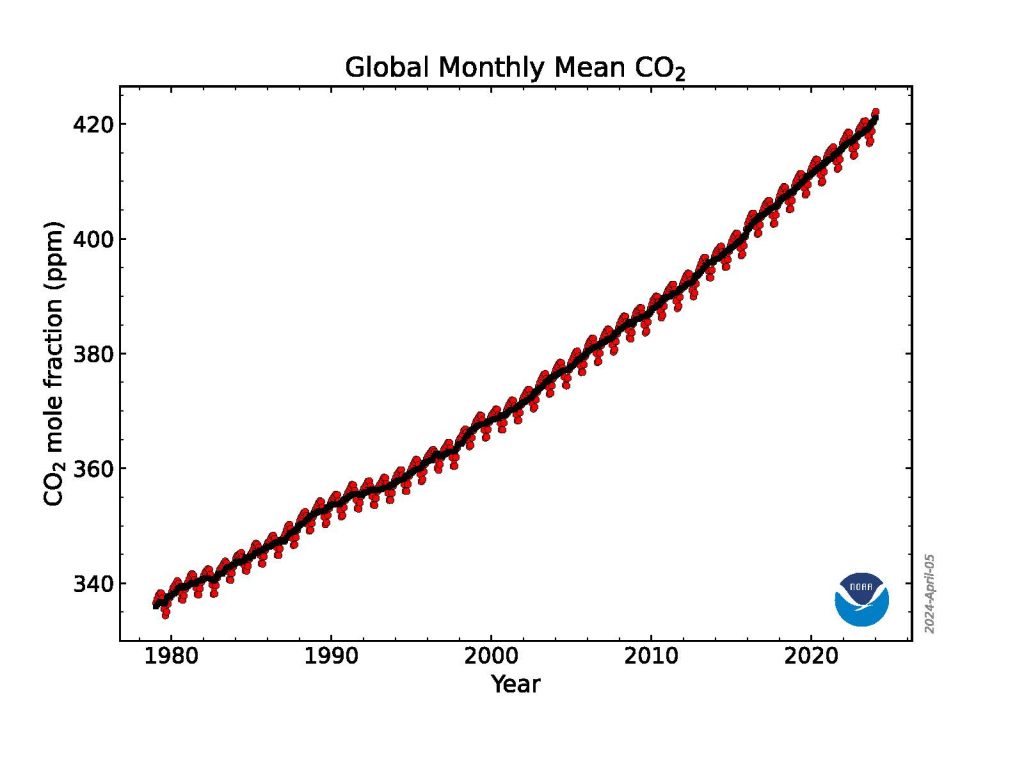
The primary driving force behind the current climate change is due to an increase in atmospheric carbon dioxide from the burring of fossil fuels.
This graph shows the globally averaged monthly mean carbon dioxide abundance measured at the Global Monitoring Laboratory’s global network of air sampling sites since 1980. Data are still preliminary, pending recalibrations of reference gases and other quality control checks. Credit: NOAA GML
How It Works
You probably already understand the very basics of how climate change works, that carbon dioxide traps heat on the planet; however, it is actually a bit more complicated than that. In this video by Doctor Sabine Hossenfelder, she explains those details
The lower atmosphere, where we live, is known as the troposphere, and in this region the air temperature decreases with increasing altitude. At the top of the troposphere is a region where with increasing altitude the temperature doesn't change much, this is the tropopause. Above the tropopause the air temperature increases with increasing altitude, and this is known as the stratosphere. The ozone layer is in the lower part of the stratosphere.
Since 1967, it was predicated that increasing the concentrations of atmospheric carbon dioxide the troposphere warms (this is global warming), but the stratosphere will cool, and the effect is stronger at higher altitudes. For the last several decades this has been measured, and there is approximately a decrease in 0.5 °C per decade. If it were the case that climate change was caused by an increase in energy output by the Sun then both the stratosphere and the troposphere would warm; however, because the troposphere warms and the stratosphere cools we know that climate change the result of an increase in atmospheric carbon dioxide and is therefore anthropogenic.
The image below from a UCLA-led group shows the trend in the change in temperature of the atmosphere at six different altitudes, and the image shows that at all latitudes the troposphere warms and the stratosphere cools.
From 1986 to 2022, temperatures declined in the higher levels of Earth’s atmosphere (starting at top left, blue shades) while increasing in the layers of atmosphere closest to the Earth’s surface (bottom row, red shades). Credit: Benjamin Santer, UCLA
Practice and Apply
PROMPT What is stratospheric cooling?
Answer
This is the effect where the upper atmosphere has cooled by about 0.5°C; per decade.